
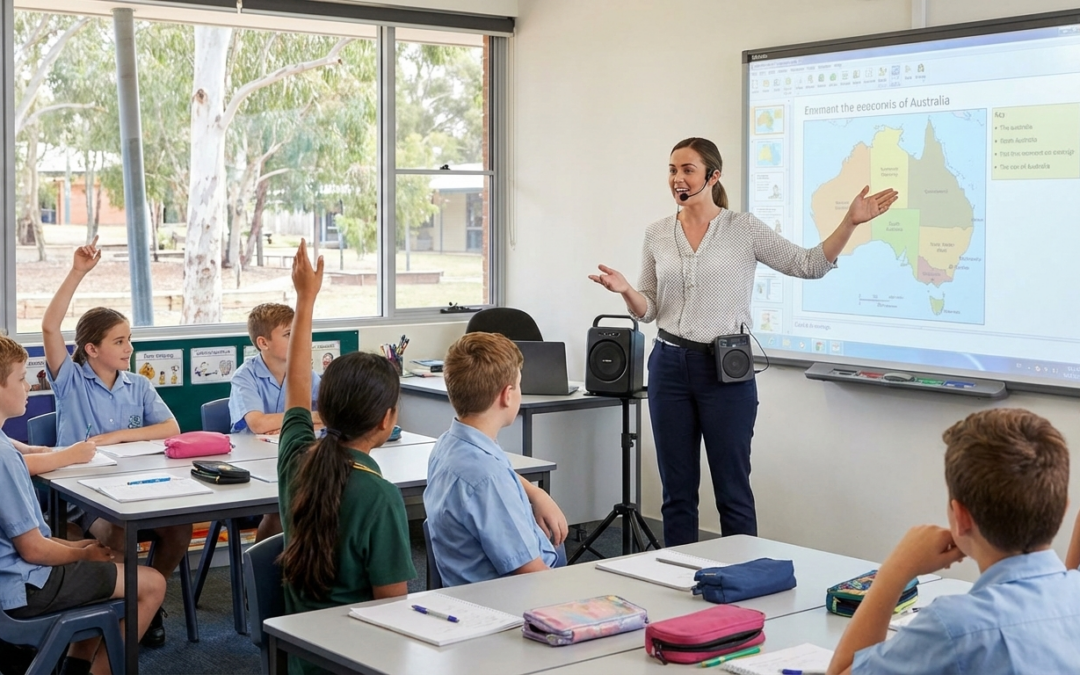
By 3pm on a Wednesday afternoon, Sarah’s throat feels like sandpaper. Her voice has dropped to a raspy whisper, and the Year 5 class at the back of the room are leaning forward, straining to catch her instructions. She’s only 28, three years into her teaching career, and already she’s developed chronic laryngitis that flares up every term.
Sounds dramatic?
It’s happening in Australian classrooms right now, every single day. Teachers are sacrificing their vocal healthand student learning outcomesbecause the basic acoustic infrastructure simply doesn’t exist to support effective communication across modern learning spaces.
Why Traditional Teaching Methods Fail Acoustically
Here’s what nobody tells you at university: the human voice wasn’t designed to project across 8-metre classrooms for six hours daily, five days a week, nine months a year. Modern classrooms present particularly brutal acoustic challenges. Open-plan learning spaces mean sound bleeds between zones. Hard surface tiles, concrete, and glass walls create reverberation that muddles speech clarity. Air conditioning hums constantly. Chairs scrape. Thirty students create ambient noise hovering around 50-60 decibels.
Against this acoustic chaos, a teacher’s unamplified voice delivers perhaps 65-70 decibels at its source, degrading rapidly with distance. By the time sound reaches students 5-6 metres away, it’s competing directly with background noise, creating a Signal to Noise Ratio that makes comprehension exhausting for students and vocally devastating for teachers.
The costs accumulate. Teachers lose instructional time when they must repeat information, manage behaviour from students who didn’t hear instructions, and deal with disengagement from learners who’ve tuned out. Students miss crucial learning and potentially fall behind academically, all because of acoustics, not ability.
What Voice Amplification Systems Actually Are
Strip away the technical jargon, and a voice amplification system is beautifully straightforward: technology that makes teachers’ voices consistently audible to every student whilst protecting those teachers from vocal damage.
The basic components work together seamlessly. A wireless microphone typically worn as a lapel clip or headset captures the teacher’s voice. This audio transmits wirelessly to an amplifier connected to strategically positioned speakers throughout the classroom. The speakers project clear, evenly distributed sound that reaches every corner at consistent volume and clarity.
Quality systems incorporate digital signal processing that analyses incoming audio in real-time, automatically adjusting for fluctuating background noise whilst preserving natural vocal quality. (For a comprehensive look at what voice amplification systems are and when they’re most beneficial, we’ve covered the fundamentals in detail elsewhere.)
The result? Teachers speak at comfortable, conversational volumes whilst every student receives clear audio regardless of seating position or ambient noise conditions.
Why Every Classroom Needs Voice Amplification
Let’s be real for a second: voice amplification systems shouldn’t be considered optional equipment. They’re fundamental infrastructure that every learning space requires.
Teacher vocal health provides the most immediate benefit. Vocal strain affects an estimated 50-60% of Australian teachers at some point in their careers. Teachers using voice amplification systems report dramatic reductions in throat discomfort, hoarseness, and end-of-day vocal fatigue. They maintain vocal quality throughout their entire teaching day and career, avoiding the chronic laryngitis and vocal nodules that plague teachers relying solely on unamplified voices.
Student learning outcomes improve measurably. When students don’t strain to hear, they maintain attention longer and process information more efficiently. Research demonstrates consistent improvements: better reading comprehension, enhanced mathematical problem-solving, and reduced behavioural referrals. We’re talking 10-15% improvements in some studies, particularly for students previously most disadvantaged by poor acoustics. (Our article on classroom voice amplification, enhancing learning for all students, explores these equity benefits comprehensively.)
Inclusive education becomes genuinely achievable. Students with hearing difficulties, auditory processing disorders, English language learners, and children with attention challenges all benefit disproportionately from clear, amplified instruction. These students finally compete on level playing fields where acoustic accessibility doesn’t create artificial learning barriers.
Flexible pedagogy expands when teachers don’t need to stay at the front to be heard. Voice amplification enables movement throughout the space, supporting contemporary teaching approaches like differentiated instruction and collaborative group work. Outdoor learning and non-traditional spaces become acoustically viable.
Making Voice Amplification Work in Practice
Installing equipment represents only half the equation. Effective implementation requires teacher buy-in, proper training, and consistent usage protocols.
Teacher training determines whether expensive systems gather dust or transform classroom communication. Staff need a comprehensive introduction: how microphones work, proper wearing techniques, battery management, and troubleshooting common issues. Hands-on practice sessions where teachers experiment with the technology in low-stakes environments build confidence before implementing systems with students. (For detailed guidance on implementation, check out our guide on how to use voice amplifiers effectively in classroom settings.)
Student education supports successful adoption. When students understand why teachers use microphones protecting vocal health whilst ensuring everyone hears clearly they respect the technology rather than viewing it as unnecessary.
Consistent usage protocols ensure systems fulfil their potential. Teachers must commit to wearing microphones throughout the instructional day, not just during “important” lessons. The benefits only materialise with routine usage. Battery management deserves specific attention establishing charging stations and replacement schedules to prevent frustrating mid-lesson failures.
Addressing Common Objections
Despite overwhelming evidence, some teachers remain sceptical. Let’s tackle typical objections directly.
“It feels unnatural wearing a microphone.” This discomfort typically disappears within 2-3 weeks. Modern microphones are lightweight and unobtrusive. Think of it like wearing glasses initially noticeable, quickly forgotten, enormously beneficial.
“The technology will malfunction.” Quality systems from established manufacturers offer excellent reliability when properly maintained. Yes, occasional issues arise, but these pale compared to the daily damage teachers inflict on their voices without amplification.
“It’s too expensive.” Compare the cost against teacher sick leave expenses, vocal health treatment, and reduced student learning outcomes. Voice amplification systems represent remarkably cost-effective investments. Many schools start with pilot programs, demonstrating value before wider rollout.
Selecting Systems That Actually Work
- Audio quality should be your primary criterion. The goal isn’t making teachers louder, it’s making them clearer. Quality systems preserve natural vocal characteristics and remain distortion-free. Demo systems in actual classroom environments rather than relying on online reviews.
- Coverage patterns determine how effectively systems distribute sound. Rectangular classrooms need different configurations than L-shaped rooms or open-plan spaces. Professional acoustic assessment identifies optimal speaker positioning for even coverage.
- Microphone options should match teaching styles. Lapel microphones offer hands-free operation. Headset microphones provide consistent positioning. Most teachers find headset or lapel microphones most practical for daily use.
- Integration capabilities matter as classrooms incorporate diverse technology. Systems should connect with interactive displays, computers, and school networks. Bluetooth connectivity enables wireless audio streaming.
- Durability and support prevent your investment from becoming expensive paperweights. Robust construction, comprehensive warranties, and local technical support ensure long-term reliability. (For detailed guidance on system selection, our guide on choosing the best voice amplification system for your specific classroom needs covers the essential decision criteria.)
Moving Forward: Implementation Strategies
Strategic implementation ensures successful adoption rather than expensive failure.
- Pilot programs in 3-5 classrooms allow you to demonstrate value before schoolwide rollout. Select diverse pilot teachers to show that amplification benefits all contexts. Collect data on teacher vocal health and student engagement to quantify improvements.
- Staged rollout spreads costs across multiple budget cycles. Prioritise classrooms with the greatest need: poor acoustics, the largest class sizes, teachers with vocal health issues, or spaces serving students with hearing difficulties.
- Professional learning throughout implementation prevents systems from being installed but rarely used. Ongoing support maintains momentum and addresses barriers as they emerge.
Voice amplification systems have shifted from specialised equipment to essential infrastructure that every modern learning space requires. The evidence is overwhelming: teacher vocal health improves, student learning outcomes rise, inclusive education becomes achievable, and contemporary pedagogy gains the acoustic support it needs to succeed.
Schools delaying implementation aren’t saving money; they’re accepting ongoing costs in teacher sick leave and compromised student learning that far exceed the investment in proper acoustic infrastructure. The question isn’t whether voice amplification belongs in classrooms. It’s how quickly we can implement systems that protect teacher health whilst ensuring every student has equal acoustic access to instruction.
Ready to transform classroom acoustics at your school?
Call us on 1800 966 266 to discuss voice amplification solutions that protect teacher vocal health whilst delivering clear, consistent audio to every student. Our experienced team has been supporting Australian schools since 1993, and we’ll help you select, install, and implement systems that genuinely work.
Recent Comments