
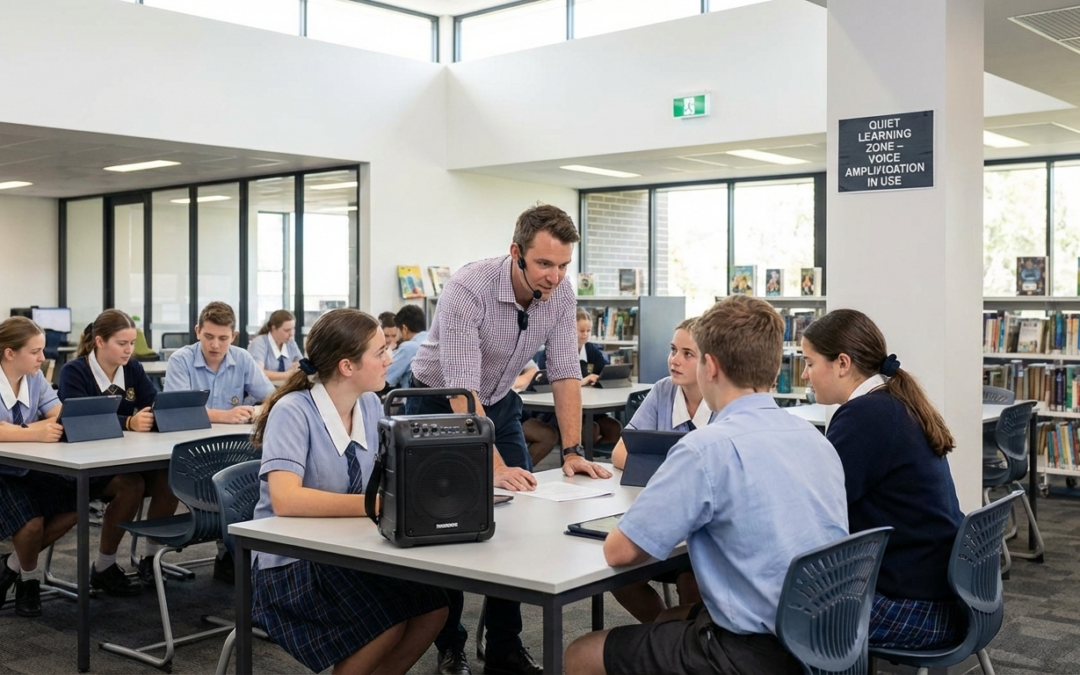
Picture this: a teacher battling to project their voice across a Year 8 science lab whilst students in the back row squint and strain, catching only half of what’s being said. Sound familiar? The frustration is palpable. Students zone out. Teachers develop vocal strain by lunchtime. Learning suffers.
This scenario plays out in Australian classrooms daily. But there’s a solution that’s gaining serious traction across schools alike. We’re talking about voice amplification systems technology that’s quietly revolutionising how effectively educators communicate with their students.
Why Voice Clarity Matters More Than You Think
Here’s the thing: when students can’t hear properly, they’re not just missing words. They’re losing context. Nuance. The entire thread of a lesson can unravel because someone in row four couldn’t catch whether the teacher said “magnesium” or “manganese.”
Research backs this up powerfully. Studies demonstrate that even mild hearing difficulties, the kind caused by classroom acoustics, not medical conditions can significantly hamper a student’s ability to absorb information. When audio clarity improves, comprehension rates climb. Retention strengthens. Academic performance follows suit.
The maths classroom presents a particularly telling example. Mathematical concepts require precision. A student who mishears “positive three” as “plus a three” might struggle with an entire algebraic equation. Small audio gaps create large knowledge chains.
The Acoustic Challenge in Modern Classrooms
Australian classrooms weren’t designed with acoustics as the primary concern. Hard surfaces dominate. Ceilings reflect sound. Background noise from air conditioning units, neighbouring classes, and outside traffic creates a constant hum that teachers must overcome.
Let’s be real for a second: even brand-new facilities struggle with this. A state-of-the-art building in Melbourne’s outer suburbs might have excellent lighting and temperature control, yet still force teachers to strain their voices competing against echo and reverberation.
Teachers aren’t stadium performers. They shouldn’t need to shout themselves hoarse by 3pm. That’s where voice amplification comes into play, acting as an equaliser that brings every student regardless of where they’re seated into the auditory sweet spot.
How Voice Amplification Systems Actually Work
Think of it as giving every teacher a personal sound engineer. A small wireless microphone clips onto the teacher’s collar. Their voice gets captured, amplified, and distributed through strategically placed speakers around the classroom. The result? Crystal-clear audio that reaches every corner without the teacher raising their voice unnaturally.
The beauty lies in the subtlety. When properly calibrated, students barely notice the technology. They simply find themselves hearing better, concentrating more easily, and understanding concepts on the first explanation rather than the third.
Word of Mouth Technology has observed remarkable shifts in classroom dynamics once these systems get installed. Teachers report less vocal fatigue. Students demonstrate improved focus. The learning environment transforms from a daily battle against acoustics into a space where communication flows naturally.
When Can You Use Voice Amplification System
The applications extend far beyond the standard lecture format. Consider these scenarios:
During group work:
Teachers move between student clusters, offering guidance. The amplification system ensures instructions reach all groups simultaneously, preventing the endless repetition that eats into productive learning time.
For students with specific needs:
Those with auditory processing difficulties, hearing impairments, or attention challenges benefit disproportionately. The technology doesn’t single them out, it lifts everyone.
In practical subjects:
Science labs, workshops, art studios these active learning spaces generate ambient noise. A voice amplification system cuts through the clatter, keeping everyone on task.
Throughout the school day:
From morning roll call to afternoon assemblies, consistent audio quality reduces cognitive load. Students aren’t working overtime just to decode what’s being said.
The Comprehension Connection
Why does clearer audio translate to better comprehension? The explanation involves cognitive psychology. When students struggle to hear, their brains divert processing power towards decoding garbled words rather than understanding meaning. It’s exhausting. Concentration wavers. Retention drops.
Use a voice amplifier in the classroom and watch this dynamic reverse. Mental energy previously spent on “What did she say?” gets redirected toward “What does this concept mean?” The shift seems small. The impact proves substantial.
Australian educators working in multicultural environments report particularly strong results. Students learning English as an additional language already face linguistic challenges. Poor audio quality compounds their difficulties unnecessarily. Clear amplification levels the playing field, giving these students a fair shot at following lessons in real-time.
Choosing the Best Voice Amplification System
Not all systems deliver equal results. The market offers everything from basic PA setups to sophisticated installations with multiple speakers and automatic volume adjustment. So what should schools consider?
Coverage patterns matter:
A single front-facing speaker won’t reach students in the back corners. Distributed systems with speakers positioned throughout the room create uniform audio coverage.
Wireless freedom counts:
Teachers need mobility. Tethered microphones restrict movement and limit teaching style. Modern systems use reliable wireless connections that don’t cut out mid-sentence.
Battery life affects practicality:
Systems requiring frequent charging become annoying quickly. Look for solutions that last a full school day or longer.
Sound quality trumps volume:
Louder isn’t necessarily better. The goal involves natural-sounding amplification that enhances rather than distorts the teacher’s voice.
Beyond the Classroom: Whole-School Applications
Voice amplification isn’t confined to individual classrooms. School halls, gymnasiums, outdoor areas and anywhere staff need to communicate with groups of students benefit from quality audio systems. Assembly announcements become clear. Sports instructions reach the entire oval. Emergency procedures get heard by everyone immediately.
The investment scales beautifully. Start with classrooms where vocal strain or comprehension issues prove most problematic, then expand as results demonstrate value.
Real Results from Australian Schools
Schools implementing voice amplification consistently report measurable improvements. Teacher sick days for vocal strain decrease. Student engagement scores rise. Behavioural incidents linked to students not following instructions drop noticeably.
A primary school in Brisbane’s northern suburbs documented a 15% improvement in literacy assessment scores after installing systems in their early years classrooms. Teachers attributed the gains to students hearing phonics lessons clearly particularly crucial when distinguishing similar sounds.
Secondary schools notice benefits too. ATAR subjects require dense information transfer. When every word reaches every student clearly, lesson efficiency improves dramatically.
The Bottom Line for Student Learning
Choose the best voice amplification system and you’re investing in more than technology. You’re removing a barrier that’s been hampering learning effectiveness for generations. The classroom acoustic environment directly influences how well students comprehend, retain, and apply knowledge.
For Australian schools navigating tight budgets and competing priorities, voice amplification offers compelling ROI. The technology pays for itself through improved educational outcomes, reduced teacher absenteeism, and enhanced classroom management.
Education shouldn’t require students to be expert lip-readers or teachers to be vocal athletes. Clear communication forms the foundation of effective learning. Voice amplification ensures that foundation stays solid, lesson after lesson, day after day.
Ready to transform communication and comprehension in your school? Explore how professional voice amplification solutions can make every word count. Because when students hear clearly, they learn effectively. Simple as that.
Recent Comments