
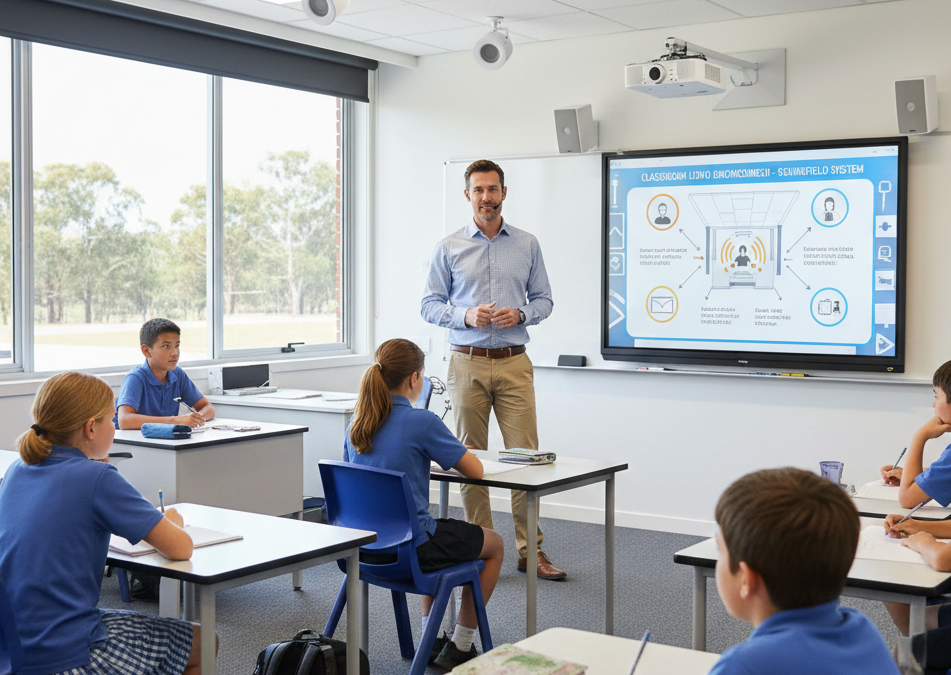
Here’s the thing about classrooms in 2026: they’re noisier than ever. Open-plan learning spaces, collaborative activities, air conditioning units humming away, chairs scraping across floors, and thirty excited young minds all competing for auditory space. Teachers raise their voices by mid-morning, students in the back row miss instructions, and by afternoon, everyone’s mentally exhausted from the constant strain of trying to hear.
This is precisely why soundfields have become non-negotiable in modern Australian schools.
What Actually Are Soundfields?
Think of a soundfield system as the great equaliser for classroom acoustics.
At its core, a soundfield is an audio amplification system designed to distribute a teacher’s voice evenly throughout an entire learning space. It consists of a wireless microphone worn by the teacher and strategically positioned loudspeakers that project their voice to every corner of the room. But here’s where it gets interesting: quality soundfield systems don’t just make voices louder. They make voices clearer, cutting through background noise whilst maintaining natural vocal quality that doesn’t fatigue young ears.
The technology operates on a beautifully simple principle: the signal (teacher’s voice) must consistently rise above the noise (everything else) to create a positive Signal to Noise Ratio, or SNR as the acoustics experts call it. When you’ve got a positive SNR, students don’t need to strain, concentrate harder, or constantly ask “Can you repeat that?”
They can just learn.
How Soundfield Technology Works in Practice
Let’s break down the mechanics without getting too technical.
When a teacher speaks into their wireless microphone, the system captures their voice and transmits it either via radio frequency, infrared, or digital wireless connection to one or more loudspeakers positioned around the classroom. These speakers then amplify and distribute the sound evenly, typically raising the teacher’s voice by about 8-10 decibels above ambient classroom noise.
That might not sound like much. But acoustically speaking, it’s the difference between effortless comprehension and exhausting concentration.
Modern soundfield systems from brands like FrontRow and Phonak Roger incorporate sophisticated digital signal processing. This means they analyse incoming audio in real-time, automatically adjusting for fluctuations in background noise levels whilst filtering out unwanted sounds like air conditioning hum or external traffic noise. Some advanced systems even feature dynamic FM technology and proprietary algorithms like OptiVoice, which optimise voice clarity specifically for educational environments.
The better systems also offer multi-microphone functionality, allowing students to participate in discussions without their voices getting lost in the acoustic chaos. When a Year 3 student shares their weekend story from the mat, everyone hears it, not just the kids sitting closest.
Why Soundfields Matter More Than Ever
Australian educational standards are evolving rapidly, and acoustics finally get the attention they deserve.
The Victorian School Building Authority (VSBA) guidelines and National Construction Code (NCC) requirements now recognise what research has demonstrated for years: poor classroom acoustics directly impact learning outcomes. But compliance alone shouldn’t be your goal here. We’re talking about creating genuine equity of access for every student, regardless of where they sit, whether they have hearing difficulties, or if English is their second language.
Consider this: research consistently shows that children need a Signal to Noise Ratio of +15dB to learn effectively, compared to just +6dB for adults. Their developing auditory systems simply work harder to process speech in noisy environments. Without soundfield amplification, students in typical Australian classrooms particularly those with ceiling fans, poor acoustic treatment, or positioned near busy roads miss significant portions of verbal instruction.
The consequences ripple outward. Students disengage when they can’t follow lessons. Behaviour deteriorates when instructions aren’t clearly heard. Academic performance suffers. Teachers burn out from vocal strain, and schools face higher staff absenteeism and turnover.
The Real-World Benefits for Schools
Let’s talk about practical outcomes, because that’s what matters. (For a deeper dive into the comprehensive advantages these systems deliver, check out our detailed guide on the benefits of sound field systems.)
For students, soundfields eliminate the cognitive overload of constant straining to hear. Attention spans increase. Information retention improves. Academic performance rises across the board, with particularly dramatic benefits for students with auditory processing difficulties, English language learners, and those with mild hearing loss who might otherwise struggle silently. The technology creates a level playing field where every child has equal acoustic access to learning.
For teachers, the benefits are immediately tangible. No more projecting your voice by 11am. No more hoarseness by Friday afternoon. No more repeating instructions five times because half the class didn’t hear you the first go round. Using a soundfield microphone means speaking at a comfortable, conversational volume whilst reaching every student. The reduction in vocal strain alone prevents countless sick days and extends teaching careers.
For schools, the investment pays dividends through reduced staff absenteeism, better teacher retention, improved student outcomes, and genuine compliance with accessibility standards. When you install quality soundfield systems like the FrontRow Juno in your classrooms or the portable Lyrik for outdoor learning, you’re not just ticking boxes. You’re fundamentally improving your school’s acoustic environment.
Soundfields for Different Learning Spaces
Not all classrooms are created equal, which means not all soundfield solutions should be either.
Traditional rectangular classrooms with standard ceiling heights work beautifully with wall-mounted or ceiling-mounted systems like the ezRoom Elevate, which integrate seamlessly with your existing audiovisual infrastructure. These installed systems provide consistent, reliable coverage and can connect to school-wide paging and bell systems through platforms like FrontRow Conductor.
Open-plan learning spaces present unique acoustic challenges, sound doesn’t stop at invisible boundaries, and competing audio from adjacent learning zones can create chaos. These environments require carefully designed multi-speaker arrays with focused coverage patterns that minimise acoustic bleed between zones. Specialist soundfield installers assess the space, measure reverberation times, and position speakers to create distinct acoustic zones within the larger environment.
Portable solutions matter too. Physical education classes, outdoor learning on the oval, excursions, and assemblies all benefit from soundfield amplification. Systems like the FrontRow ToGo deliver powerful, battery-operated amplification that travels wherever learning happens, ensuring students hear their teacher whether they’re learning in the STEM lab or practicing cricket on the oval.
Music rooms, drama studios, and specialist learning spaces each present their own acoustic puzzles. The key is matching the soundfield technology to the specific acoustic challenges and usage patterns of each space, rather than applying a one-size-fits-all solution.
Choosing the Right Soundfield System
Here’s what you actually need to consider when selecting soundfields for your school.
Start with the physical characteristics of your learning spaces: ceiling height, room dimensions, surface materials, ambient noise levels, and existing acoustic treatment all influence system selection. A carpet-floored primary classroom with acoustic ceiling tiles needs different amplification than a hard-surfaced secondary science lab with concrete floors and minimal sound absorption.
Think about usage patterns. Will teachers move between rooms, or does each space need its own microphone? Do you need multiple microphones for student participation? Will the system integrate with existing technology like interactive whiteboards, document cameras, or distance learning platforms?
Budget matters, but consider total cost of ownership rather than just upfront price. Quality systems from established manufacturers include comprehensive warranties, ongoing technical support, and training packages that ensure staff actually use the technology. Cheaper alternatives often lack crucial features like automatic gain control, have limited battery life on wireless microphones, or produce audio quality that fatigues listeners rather than supporting them.
Australian schools should also consider compliance requirements. Systems must meet relevant standards including the Disability Discrimination Act, NCC provisions for accessible design, and any state-specific guidelines like the VSBA requirements in Victoria. Working with experienced soundfield specialists who understand these regulatory frameworks saves considerable headaches during planning approval and construction phases.
Professional Installation and Training
Let’s be real for a second: even the best soundfield technology fails if teachers don’t use it correctly or if installation is substandard.
Professional installation ensures speakers are optimally positioned for even coverage, wireless systems are properly configured to avoid interference, and integration with existing technology works seamlessly. This isn’t a job for the school’s tech-savvy maintenance person; it requires acoustic measurement equipment, understanding of RF propagation, and experience with educational spaces.
Equally crucial is comprehensive user training. Teachers need to understand how to position and use their wireless microphones, troubleshoot common issues, and recognise when the system isn’t performing optimally. Students benefit from learning how to use pass-around microphones during discussions. Administrative staff should know how to manage battery charging, address technical hiccups, and coordinate system usage across multiple teachers.
Word of Mouth Technology, for instance, provides complete installation and training packages across metropolitan and regional Australia because we’ve learned that technology alone isn’t enough. The human element ensuring users feel confident and supported determines whether soundfields become an essential teaching tool or expensive equipment gathering dust.
The Future of Classroom Audio
Soundfield technology continues evolving, with emerging developments promising even better outcomes for Australian schools.
Networked systems now allow centralised management of multiple classrooms, automated firmware updates, and usage analytics that help schools optimise their investment. Artificial intelligence is beginning to enhance audio processing, with algorithms that can distinguish between valuable speech and unwanted noise with increasing sophistication. Integration with learning management systems means lesson audio can be captured and made available for students to review, supporting both absent students and those who benefit from repeated exposure to content.
Bluetooth connectivity, USB-C integration, and improved battery technology are making systems more flexible and easier to use. But perhaps most importantly, there’s growing recognition across the Australian education sector that acoustic accessibility isn’t an optional extra, it’s fundamental infrastructure that every learning space requires.
Making Soundfields Work for Your School
If you’re convinced that soundfields deserve a place in your school’s learning spaces (and by now, hopefully you are), where do you start?
Begin with an acoustic assessment of your learning environments. Which spaces have the most challenging acoustics? Where do teachers report the most vocal strain? Which student populations would benefit most from improved speech intelligibility? This prioritisation helps target your investment where it’ll make the biggest difference.
Engage with experienced suppliers who understand Australian educational requirements and can offer ongoing support. Look for demonstrated experience in school installations, comprehensive product training, and a track record of post-installation service. The cheapest quote isn’t always the best value when you factor in system reliability, audio quality, and long-term support.
Consider starting with a pilot program in a few classrooms. This allows teachers to experience the benefits firsthand, generates internal advocacy, and helps you refine your approach before wider rollout. Schools that implement soundfields gradually, with proper training and support, achieve far higher adoption rates than those attempting overnight whole-school installations.
The evidence is clear: soundfields transform classroom acoustics, reduce teacher vocal strain, improve student learning outcomes, and create genuinely inclusive learning environments where every child has equal access to their teacher’s voice. In an era where open-plan learning, collaborative pedagogy, and inclusive education are the norm rather than the exception, soundfield technology has shifted from luxury to necessity.
Your teachers’ voices matter. Your students’ learning matters. The acoustic environment that connects them matters too.
Ready to improve classroom acoustics at your school?
Word of Mouth Technology has been supplying and installing soundfield systems across Australian schools since 1993. Our experienced team can assess your learning spaces and recommend solutions that do more than just meet compliance standards; they genuinely enhance the educational experience for your entire school community. Ring us on 1800 966 266 or visit our website to discuss how soundfields can transform your classrooms.
Recent Comments